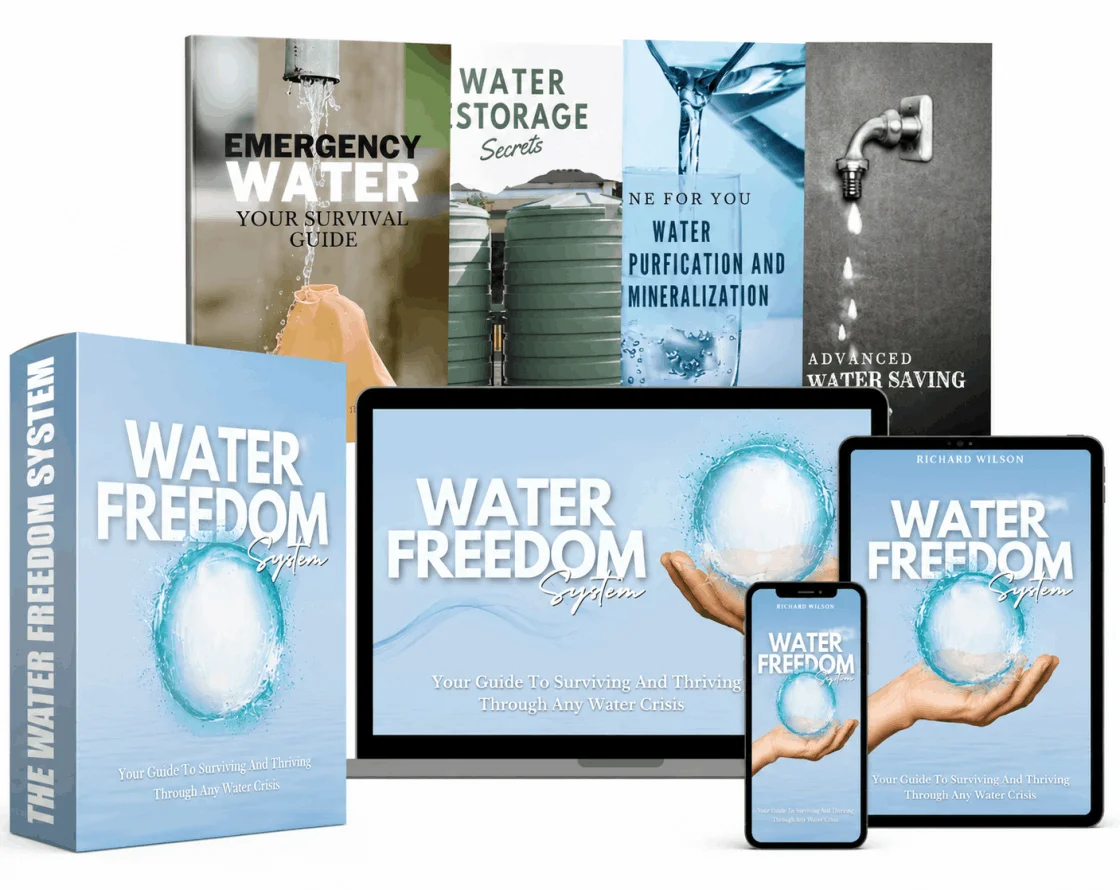
⚡ LIMITED-TIME OFFER — SAVE ON THE WATER FREEDOM SYSTEM™ DIGITAL GUIDE TODAY ⚡

Water Freedom System™: Complete Guide to Making Water From Air at Home

The Water Freedom System is a digital DIY guide built around an intriguing idea: using moisture naturally present in the atmosphere to create water at home through condensation, collection, and filtration.

At first glance, the concept of getting water from air can sound almost unbelievable. However, the underlying principle is real. Atmospheric water generation uses the same basic phenomenon that causes droplets to appear on the outside of a cold glass on a warm, humid day.

What makes the Water Freedom System different from a conventional water filter or commercially manufactured atmospheric water generator is its DIY approach. Instead of receiving a finished appliance, buyers receive educational material, instructions, plans, and related guidance intended to help them understand and assemble a system themselves.

Shop Water Freedom System
water freedom system

A Structured Way to Explore Atmospheric Water Generation

Digital instructions, diagrams and guidance for building a DIY atmospheric water system at home.

💧

Step-by-Step Guidance

Structured instructions covering airflow, cooling, condensation, filtration and storage.

📘

Digital Access

No physical box to wait for — begin researching the project as soon as you purchase.

🛡️

60-Day Guarantee

The reference websites advertise a 60-day, 100% money-back guarantee, processed through ClickBank.

60-DAY 100% MONEY-BACK GUARANTEE — REFUNDS PROCESSED THROUGH CLICKBANK
Testimonials

Customer Reviews and Experiences

Illustrative sample testimonials — replace with genuine, documented customer reviews before publishing.

Michael R. — verified reader
Michael R.
Arizona, USA
★★★★★

"I was initially interested because I wanted to understand how atmospheric water generation actually works. The guide made the condensation process easier to understand and gave me a clearer picture of the components involved. I especially liked that the concept could be approached as a DIY project instead of immediately buying an expensive commercial unit."

Sarah T. — verified reader
Sarah T.
North Carolina, USA
★★★★☆

"The biggest value for me was learning about the technology. I had heard about getting water from air but didn't really understand the science behind it. The guide helped explain humidity, condensation and filtration in a much more practical way. I would recommend understanding your local climate before investing heavily in components."

Daniel P. — verified reader
Daniel P.
Florida, USA
★★★★★

"I enjoy DIY projects, so the idea immediately caught my attention. What I liked most was understanding how airflow and cooling work together to collect moisture. It's definitely not a plug-and-play appliance, but for someone interested in building and learning, the concept is fascinating."

4.2 / 5
The Guide

What Is Water Freedom System?

The Water Freedom System is presented as a digital instructional program focused on DIY atmospheric water generation. The core concept is straightforward: Air → Moisture → Condensation → Collection → Filtration → Storage.

Rather than starting with an existing water source, the approach attempts to capture water vapor already present in surrounding air. The guide is designed around an atmospheric water generator, commonly abbreviated as AWG.

The official product material describes the program as a collection of instructions, diagrams, component information, filtration guidance, and other educational resources for exploring a DIY atmospheric water-generation setup.

💨 Airflow & Moisture
❄️ Condensation
🧪 Filtration
🪣 Collection & Storage
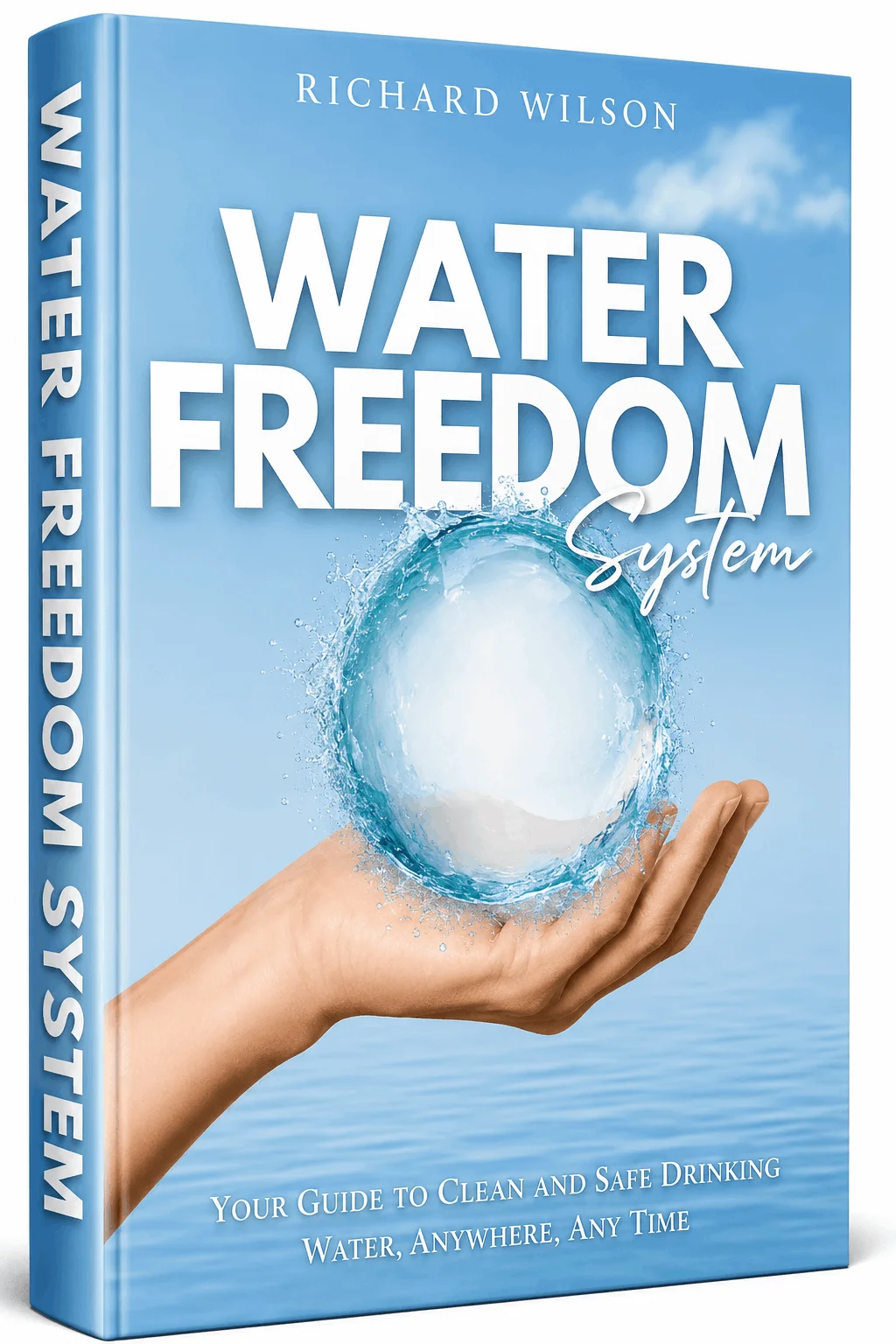
Water Freedom System guide cover Water scarcity — cracked, drought-affected irrigation channel
Inside The Guide

DIY Water Guide: What's Included?

The Water Freedom System DIY water guide is designed to provide educational and practical information rather than a finished physical product. Based on the reference material, the package is presented around several major resources.

Step-by-Step Water Generation Guide

The central guide explains the basic process of atmospheric water generation. Rather than forcing a beginner to research every component independently, the material attempts to organize the project into understandable stages. The purpose is to make the concept easier to follow and provide a starting point for assembling a DIY setup.

Atmospheric Water Blueprint

The blueprint-style information explains how major components can fit together. It focuses on concepts such as airflow, cooling, condensation, water collection, filtration, storage and environmental conditions. For someone unfamiliar with AWG technology, having the overall system explained visually can be much easier than trying to understand individual components in isolation.

Video Tutorials

The reference material also describes instructional video content. Visual demonstrations can be particularly useful when working with physical components because diagrams and explanations can show relationships that are difficult to understand from text alone.

Setup and Troubleshooting Information

DIY projects rarely go perfectly on the first attempt. The material discusses considerations around setup, maintenance, humidity, temperature, airflow, cooling efficiency, and filter condition. This can be particularly valuable because atmospheric water generation isn't simply a matter of assembling components and expecting identical output everywhere.

Water Independence Strategies

The broader material also discusses water independence, preparedness, conservation, and alternative water sources. This makes the product more than a technical explanation of condensation. It places the technology within a broader self-reliance strategy.

The Process

How Does It Work?

Understanding the Water Freedom System how it works is much easier once you understand condensation — the same process that forms droplets on a cold bottle on a humid day.

1

Air Enters the System

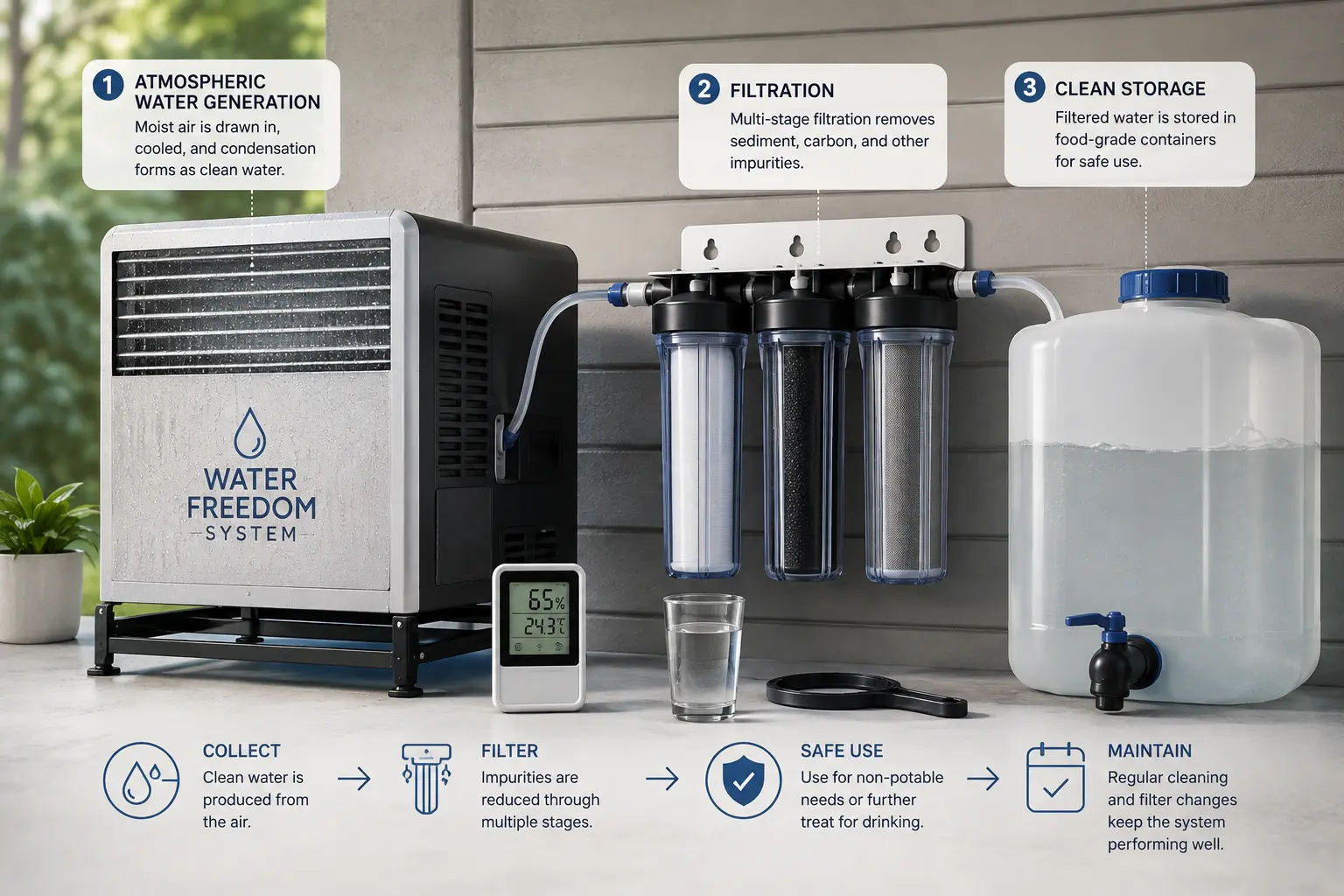
A fan or airflow mechanism brings surrounding air into the setup. Warm, humid environments generally provide more available atmospheric moisture than dry ones.

2

Moisture Reaches the Dew Point

Cooling equipment lowers the temperature of a surface. When humid air contacts a sufficiently cold surface, water vapor begins changing from gas into liquid droplets.

3

Water Is Collected, Filtered & Stored

Condensed water is directed into a collection area, then filtered and treated before being stored in a clean, food-safe container.

PLACE — position the cooling surface where humid air can reach it
PUSH — move air across the surface with adequate airflow
PULL — collect, filter and store the condensed water
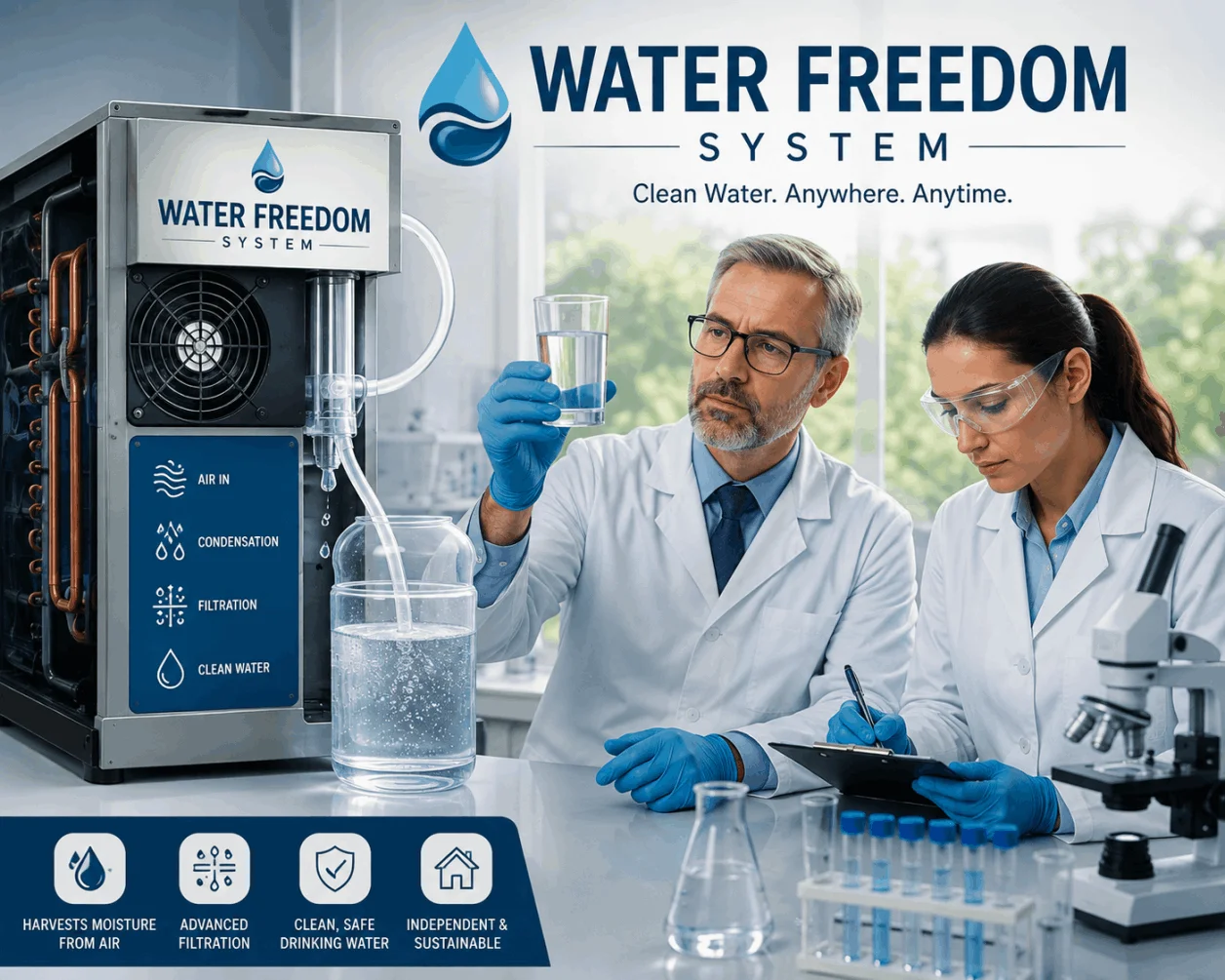
Water Freedom System — how it works: air in, condensation, filtration, clean water
Getting Started

How To Use This DIY Guide

Five stages to work through as you plan and build your DIY atmospheric water setup.

1

Review the Guide

Read through the step-by-step water generation guide before sourcing any components.

2

Study the Blueprint

Understand how airflow, cooling, condensation, collection and filtration fit together.

3

Source Components

Consider cooling equipment, airflow parts, tubing, containers and filtration materials.

4

Assemble & Test

Build the system using the instructions, then check airflow, cooling and condensation.

5

Maintain & Filter

Clean surfaces, replace filters, and verify water quality on a regular basis.

Key Features

What Makes This Guide Different

A DIY-first approach built around education, flexibility and understanding the technology.

01

Step-by-Step DIY Approach

Instead of starting with a blank sheet of paper, users receive information intended to explain how an atmospheric water system can be assembled.

02

Beginner-Oriented Explanations

The product is positioned toward homeowners and DIY learners, explaining major components and their functions in understandable language.

03

Commonly Available Components

The guide emphasizes components that may be available through hardware stores and online suppliers, such as tubing, aluminum components, fans, cooling equipment and filters.

04

Filtration Guidance

The product doesn't stop at condensation — it also discusses filtration and water treatment, since collected atmospheric water still requires responsible handling.

05

Flexible DIY Design

A DIY system can potentially be adapted according to available space, components, climate, budget, and intended output — attractive for people who dislike being locked into a single commercial appliance.

The Science

How an Atmospheric Water Generator Works

An atmospheric water generator isn't creating hydrogen and oxygen from nothing. It is harvesting water vapor that already exists in the atmosphere. That distinction matters because the amount of water available isn't unlimited.

If you're in a humid environment, there may be substantial atmospheric moisture available. In extremely dry conditions, considerably less water vapor may be available for collection.

The system therefore doesn't bypass the laws of physics. Instead, it provides a mechanism for exploiting atmospheric humidity.

"Use cooling to condense atmospheric moisture into liquid water. The science itself is straightforward. The engineering challenge is efficiency."
Humidity
Available moisture
Temperature
Affects dew point
Airflow
Moves moist air
Cooling
Triggers condensation
Water Freedom System — atmospheric water generation, filtration and clean storage process
Performance

What Determines Water Production?

An atmospheric water generator isn't creating hydrogen and oxygen from nothing. It is harvesting water vapor that already exists in the atmosphere. That distinction matters because the amount of water available isn't unlimited. If you're in a humid environment, there may be substantial atmospheric moisture available. In extremely dry conditions, considerably less water vapor may be available for collection. The system therefore doesn't bypass the laws of physics — instead, it provides a mechanism for exploiting atmospheric humidity.

What Determines Water Production? Several variables influence potential output:

Humidity

Humidity is one of the most important factors. Higher humidity generally means more water vapor is available for collection. Lower humidity means the system has less atmospheric moisture to work with.

Temperature

Temperature affects both humidity and condensation. The relationship between temperature and dew point is central to atmospheric water generation.

Airflow

The system needs to move enough air across the appropriate cooling surface. Airflow affects how much moisture reaches the condensation area.

Cooling Efficiency

The cooling mechanism needs to lower the relevant surface temperature sufficiently to create condensation. Inefficient cooling can reduce performance and increase energy consumption.

Electricity

A DIY atmospheric water generator generally needs electrical power for fans, cooling equipment, controls, or other components. Therefore, "water from air" does not mean "water without energy."

Maintenance

Dirty collection surfaces, clogged filters, contaminated containers, or poorly maintained components can negatively affect both performance and water quality.

Set Expectations

Fresh, Clean Water: What Should You Realistically Expect?

The phrase water freedom system fresh clean water should be interpreted carefully. The concept can produce condensed water, but "fresh" and "clean" aren't automatic guarantees. There are several stages between capturing moisture and having water that is appropriate for consumption.

A responsible setup needs:

The product's own material acknowledges that actual performance varies based on environmental conditions and that appropriate water-quality precautions matter.

Can It Produce Drinking Water?

The system is marketed around producing water that can be filtered and treated. However, anyone building a DIY drinking-water system should not rely solely on marketing language. The safety of the finished water depends on the construction, materials, filtration, maintenance, contamination control, and testing. That is why I would treat water testing as a worthwhile part of the project if the water is intended for regular human consumption.

The Technology

Air to Water Technology, Explained

The water freedom system air to water technology concept can be summarized in one sentence: use cooling to condense atmospheric moisture into liquid water.

The science itself is straightforward. The engineering challenge is efficiency. An effective system needs to move enough air, extract enough moisture, cool the relevant surfaces sufficiently, collect the water without contamination, and process it appropriately. This is where real-world performance becomes more complicated than a simple "air in, water out" explanation.

Why Humidity Matters So Much

Imagine two identical systems. One is operating in a warm, humid environment. The other is operating in a very dry environment. The first system has substantially more atmospheric moisture available. The second system may have to process much more air to collect the same amount of water. Therefore, a claim about maximum theoretical output shouldn't automatically be treated as your expected everyday output.

Fact Check

Is "Water From Thin Air" Really Possible?

The phrase water freedom system fresh water from thin air is essentially a consumer-friendly description of atmospheric water generation. Technically, the water isn't appearing from nowhere — it is already present as invisible vapor in the atmosphere. The system changes its physical state: water vapor is cooled until it becomes liquid water. That distinction makes the concept less mysterious and much easier to understand.

Is "Water From Thin Air" Real?

Yes, the underlying phenomenon is real. Condensation happens naturally. Atmospheric water generators simply attempt to control the process. The real question isn't whether the physics works. The more important questions are:

Those are the questions a smart buyer should consider.

Benefits

Benefits of Water Freedom System

1. Learn an Alternative Water Technology

One of the clearest benefits is educational. The water freedom system gives users an introduction to atmospheric water generation without requiring them to start by purchasing a high-priced commercial machine. You can learn the underlying concept and decide whether the technology fits your needs.

2. Explore Greater Water Independence

The system offers another possible water source to investigate. Rather than depending entirely on a single supply method, households can explore combinations of stored water, filtration, rainwater collection, traditional supplies, atmospheric water generation and water conservation. That broader approach may be more useful than treating any single technology as a magic solution.

3. Useful for Emergency Preparedness

Water interruptions can occur because of severe weather, infrastructure problems, emergencies, or temporary supply issues. A DIY atmospheric water generator may be worth exploring as one component of a larger preparedness plan — a possible additional or backup option rather than an automatic replacement for conventional water supplies.

4. Potentially Reduce Bottled-Water Dependence

If a system produces useful amounts of water for a household, it could potentially reduce reliance on packaged bottled water, reducing recurring purchases and single-use plastic consumption. However, the financial and environmental benefits depend on electricity costs, component costs, maintenance, and actual output.

5. Interesting DIY Project

For people who enjoy building things, the project itself may be part of the appeal. Learning how airflow, cooling, condensation, filtration, and storage interact can be more rewarding than simply purchasing an appliance.

6. Potential Off-Grid Application

People living in remote areas may find atmospheric water generation particularly interesting. With an appropriate power supply, the technology can potentially be investigated alongside solar energy, battery storage, water tanks, and other off-grid systems.

7. Flexible System Design

A DIY approach provides more flexibility than many preconfigured appliances. Users can potentially choose components according to availability, budget, space, and performance goals.

8. Greater Understanding of Water Security

Perhaps the broader benefit is awareness. The water freedom system encourages users to think about where their household water comes from, what happens when supply is interrupted, and what alternatives exist — a mindset that can be valuable regardless of whether someone ultimately builds the system.

Why Choose Us

Why Choose This Guide?

The strongest argument for choosing the water freedom system isn't that it magically creates unlimited water. It's that it gives curious users a structured way to investigate atmospheric water generation.

Compared with purchasing an expensive commercial appliance immediately, a digital guide can be a relatively low-cost starting point for learning about the technology. It also gives DIY enthusiasts an opportunity to understand the components rather than simply operating a sealed appliance.

The tradeoff is obvious: you have to build and maintain the system yourself. For someone who wants convenience above everything else, that may be a disadvantage. For someone who enjoys DIY projects and wants to understand how the technology works, it could be exactly the opposite.

Is This For You?

Who Should Use This Guide?

DIY Enthusiasts

If you enjoy assembling projects, learning how systems work, and sourcing components, the water freedom system may be a natural fit.

Off-Grid Living Enthusiasts

People interested in cabins, homesteads, remote properties, or self-sufficient lifestyles may want to explore atmospheric water generation as one part of their broader infrastructure.

Emergency Preppers

Preparedness-minded individuals can investigate the technology alongside stored water, filtration systems, food supplies, power backups, and other emergency resources.

Homeowners Interested in Alternative Water Solutions

If you're curious about reducing dependence on conventional water sources, the guide offers an educational introduction to one possible alternative.

Technology Enthusiasts

Anyone interested in practical applications of condensation, refrigeration, airflow, and environmental engineering may enjoy the technical side of the project.

Investment

What's the Actual Cost?

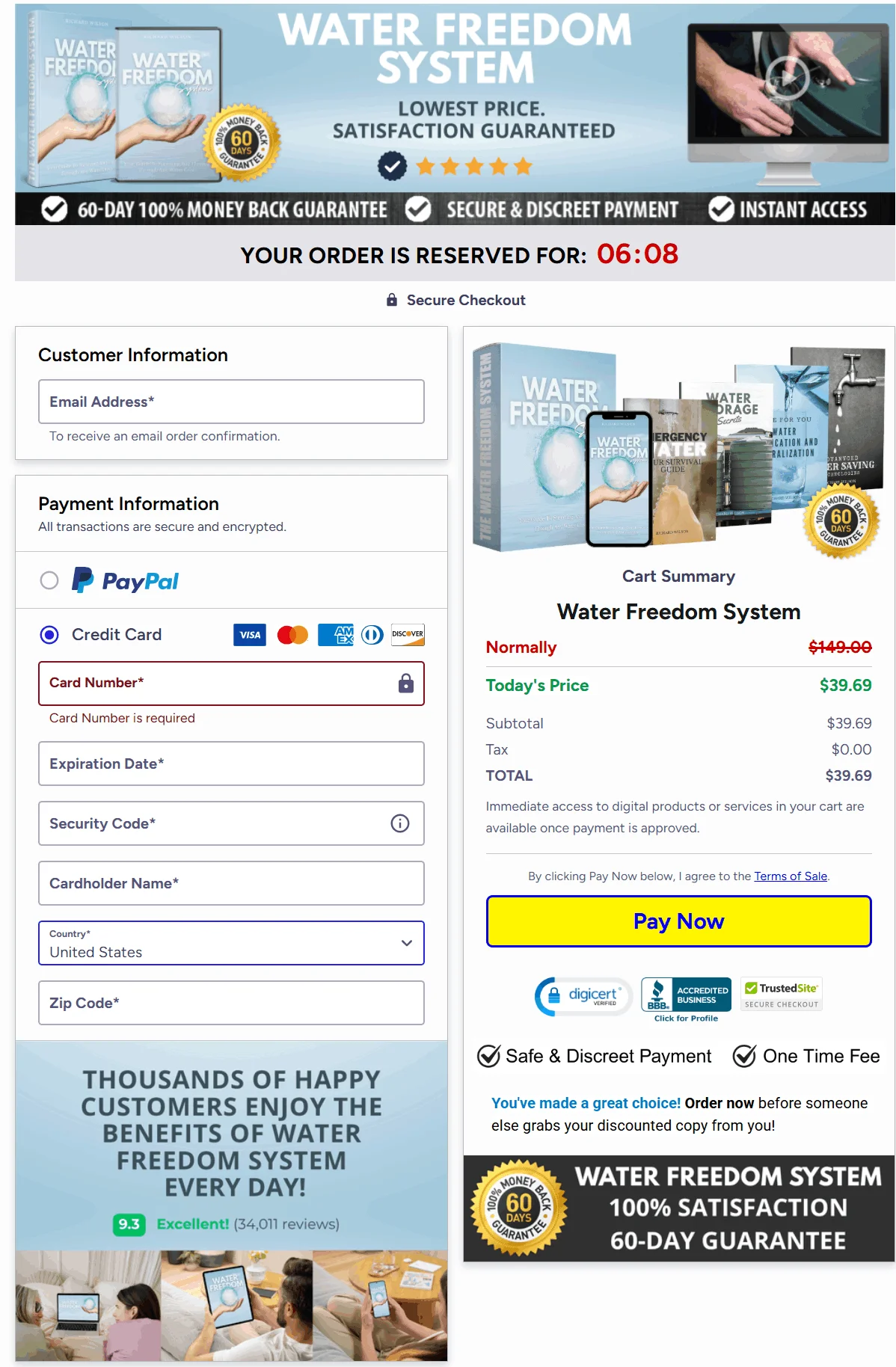
The digital guide itself appears to be offered at a promotional price on the reference websites. One current product page lists a regular price of $149 and a promotional price of $39, while another page displays approximately $39.69. Because promotional pricing can change, buyers should verify the current amount on the checkout page before purchasing.

But remember: the guide price is not the complete cost of building the physical system. A separate sales page estimates approximately $270–$600 for construction materials, depending on component quality and sourcing. That figure is a promotional estimate rather than a guaranteed build cost. Your actual cost may vary.

Water Freedom System Bonuses

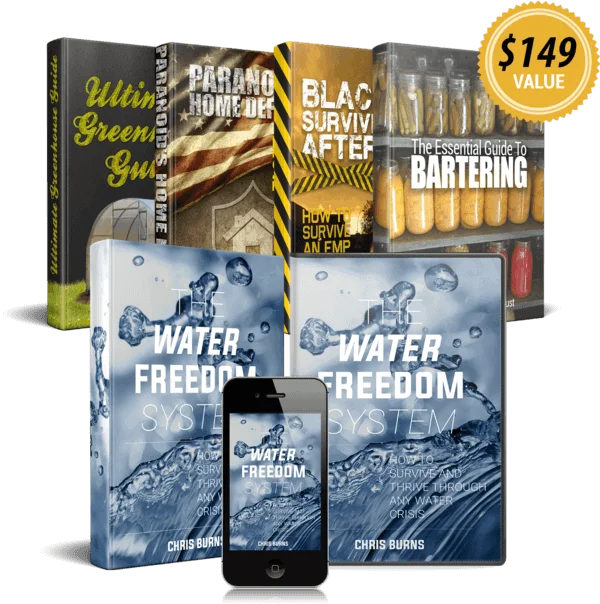
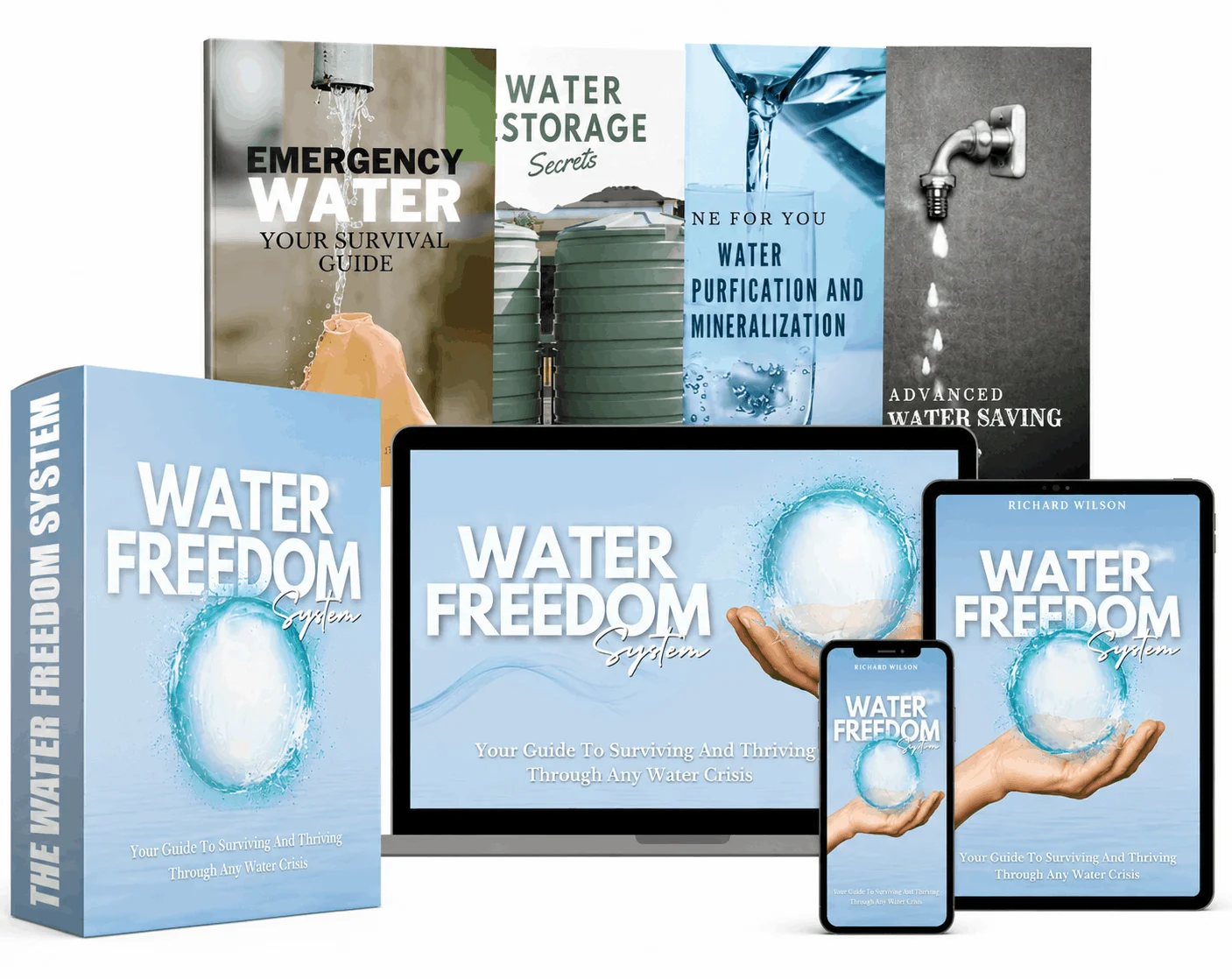
One promotional page associated with the water freedom system lists four additional digital bonuses:

Ultimate Greenhouse Guide

This bonus is positioned around growing food and extending self-reliance beyond water. For people interested in homesteading or preparedness, the topic can complement the main water-focused material.

Paranoia Home Defense

This bonus focuses on household preparedness and security. Its relevance depends on whether you're interested in broader preparedness topics rather than simply atmospheric water generation.

Blackout Surviving AfterMath

This resource is positioned around preparing for power outages and disruptions. That can be particularly relevant because an atmospheric water-generation setup may itself require electricity.

The Essential Guide To Bartering

This bonus expands the preparedness theme into resource exchange and practical self-reliance.

The four bonuses are specifically advertised on one of the reference sales pages, so buyers should confirm that they remain included with the current offer before purchasing.

Pricing

Get the Water Freedom System Guide

⏳ Promotional pricing — verify the current amount on the checkout page before purchasing
Water Freedom System guide with 4 bonus guides — $149 value

Water Freedom System — Digital Guide

$149
$39
Save [INSERT %]
✔ INSTANT DIGITAL DELIVERY + 4 BONUS GUIDES
  • Step-by-step water generation guide
  • Atmospheric water blueprint
  • Video tutorials
  • Setup & troubleshooting guidance
  • Water independence strategies
  • Ultimate Greenhouse Guide (bonus)
  • Paranoia Home Defense (bonus)
  • Blackout Surviving AfterMath (bonus)
  • The Essential Guide To Bartering (bonus)
  • 60-day money-back guarantee
Add to Cart

A separate sales page estimates approximately $270–$600 for construction materials, depending on component quality and sourcing. That figure is a promotional estimate rather than a guaranteed build cost.

Water Freedom System 100% money-back guarantee badge

Water Freedom System 60-Day Money-Back Guarantee

The reference pages advertise a 60-day, 100% money-back guarantee. The stated process is that buyers who are dissatisfied can contact support within the applicable 60-day period to request a refund. The official page states that refunds are processed through ClickBank.

The guarantee reduces the financial risk associated with purchasing the digital guide itself. However, a refund of the guide does not necessarily mean that separately purchased hardware, tools, electricity, or materials are refundable.

Anyone considering the project should avoid purchasing expensive components before understanding the design and confirming that it makes sense for their environment.

Get Started Risk-Free
The Honest Take

Pros and Cons

Pros

DIY-Friendly Concept

The guide gives users a structured starting point for exploring atmospheric water generation.

Educational

It explains condensation, airflow, collection, filtration, and other fundamentals.

Digital Delivery

No physical product shipping is required for the core guide.

Potentially Useful for Preparedness

The concept can complement a larger emergency water strategy.

Flexible

Users can investigate components according to their location and budget.

Alternative Water Source

The technology provides another possible way to obtain water rather than relying exclusively on traditional supplies.

60-Day Guarantee

The reference websites advertise a 60-day money-back guarantee.

Cons

It Is Not a Finished Machine

This is a guide, not a ready-to-use commercial AWG.

Additional Costs

You still need to purchase components and potentially tools.

FAQ

Frequently Asked Questions About Water Freedom System

Answers to common questions about atmospheric water generation and this DIY guide.

Yes. Atmospheric water generation doesn't inherently depend on sunlight. If the system has access to the required electrical power and environmental conditions are suitable, it can operate during nighttime as well.

Not necessarily, but higher humidity generally provides more available water vapor. In areas with very low humidity, collecting meaningful quantities of water can become considerably more challenging and energy-intensive.

Potentially. Indoor operation depends on factors such as room humidity, temperature, airflow, available space, electrical requirements, and the specific design being used.

An atmospheric water generator removes some moisture from the air as condensation occurs. In a closed room, prolonged operation could therefore influence local humidity, although the actual effect depends on room size, ventilation, humidity level, and water-production rate.

Yes. Air can contain dust, airborne particles, odors, microorganisms, and other contaminants. This is why appropriate materials, filtration, cleaning, and water-treatment practices are important when designing a system intended to produce water for consumption.

It can. Condensed water contains relatively few dissolved minerals compared with many conventional drinking-water sources, while the taste can also be influenced by the collection surfaces, filtration system, storage container, and surrounding environment.

Atmospheric water produced through condensation generally contains fewer naturally occurring minerals than many groundwater or mineral-water sources. Depending on the intended use, some users may consider additional mineralization or remineralization.

Water should be stored in a clean, food-safe container that is appropriate for potable water. Storage containers should be protected from contamination and cleaned regularly.

Yes. Water can become contaminated during collection, filtration, transfer, storage, or handling. Producing water through condensation is only one stage of the overall process.

The reference websites advertise a 60-day, 100% money-back guarantee, with refunds processed through ClickBank. This applies to the digital guide itself, not separately purchased components.

Water Freedom System guide with bonus guides across devices

Start Exploring Water Independence Today

Get instant digital access to the Water Freedom System guide, blueprints and video tutorials — backed by a 60-day money-back guarantee.

$149   $39
Get Instant Access Now
🔒 Secure Checkout 📩 Instant Digital Delivery 🛡️ 60-Day Guarantee ⭐ 4.2/5 Rated
Checkout

What Happens After You Click Order

🖱️

Click Order

📦

Enter Shipping

💳

Enter Payment

✅

Confirmed & Shipped

This is a one-time payment for the digital guide at checkout — no recurring subscription is created as part of this purchase.
Water Freedom System secure checkout page

🔒 Secure & Encrypted

Checkout is processed through ClickBank's secure, encrypted payment system.

VISAMASTERCARDAMEXPAYPAL

↩️ Refund Policy

60-day, 100% money-back guarantee on the digital guide. Refunds are processed through ClickBank.

💬 Support

Questions about your order or the guide? Contact support@waterfreedomsystem.com

"The guide made the condensation process easier to understand and gave me a clearer picture of the components involved." — Michael R., Arizona
"The guide helped explain humidity, condensation and filtration in a much more practical way." — Sarah T., North Carolina